Last Updated on 08/2026 by Mom Goes Camping
Want to go hiking with your baby or toddler and aren’t sure whether a stroller or hiking carrier is better? Like most things in life, there are a lot of variables to consider. Here’s my take.
Read more about strollers and hiking carriers below:
The short answer:
If you don’t mind limiting yourself to stroller-friendly paths, then hike with a stroller. It will be more comfortable for you and your child – especially if your child is older or heavier. However, strollers will really limit the places you can hike. If you are confident in your ability to carry your child and want to get off-the-beaten-path, then go with a carrier.
Personally…
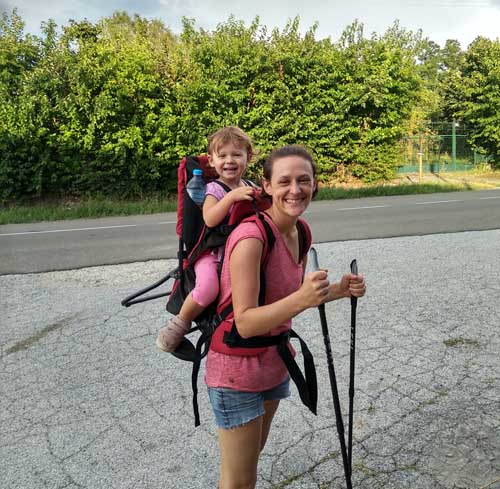
I used a carrier when my child was young and still relatively lightweight. Now that she’s a toddler, I’ve mostly resigned myself to stroller-friendly hikes. I’ll still sometimes use the carrier on tougher hikes, but make sure to keep the hike short so I don’t get exhausted.
Sometimes, I’ll even use a combo: I start with the stroller on an accessible path. When the path gets too narrow/bumpy, I’ll lock the stroller to a tree with a flexible bike lock. My daughter then goes in the carrier for the rest of the way. She goes back into the stroller on the way back.
Tips:
- Don’t mess around. Use trekking poles with a hiking carrier! It will redistribute the weight, save your back, and improve balance.
- Get a wrist strap if using a hiking stroller. Wearing it gives me peace of mind that the stroller won’t go rolling away if I fall while on a steep slope.
Still not sure whether a stroller or carrier is better?
Below are some questions to help you decide.
How Heavy Is Your Child?
When my daughter was a baby, I had no problem carrying her in a hiking carrier. But now she is two years old and weighs 28lbs. Add in the weight of the carrier (the famous Deuter Kid Comfort carrier weighs 7lbs!), water and other supplies and it gets even heavier.
Most backpacking gurus recommend you carry no more than 20-25% of your bodyweight. The UI Hospitals & Clinics Rehabilitation Services team recommends carrying no more than 10% of your bodyweight! Under that recommendation, I shouldn’t be carrying my child at all. :/
A frame hiking carrier does make it easier to carry all this weight. But they are expensive and don’t fit short, small women well.
Read:
- Best hiking child carriers for petite women
- Soft vs. frame backpack child carriers
- Expert tips for using child hiking carriers
Taking the kids camping for the first time?
My “Your Family’s First Camping Trip” bundle has the complete guide, printable packing checklist, and three done-for-you itineraries — everything from booking the site to the drive home.
Is It Safe for You to Use a Hiking Carrier?
Bear in mind that a too-heavy load (aka your child) reduces balance and makes it easier to fall. Do you really want to fall while wearing your child? I definitely turned back on some hikes because the trail was too steep and I didn’t feel comfortable carrying my child.
How Fit Are You?
I carried my first child everywhere until she was almost three years old. Back then, I was in my 20s and it didn’t faze me. My second daughter was born when I was in my 30s. What a difference a decade makes! My core muscles are also permanently weakened due to recti diastasis. Now, my back gets sore with my daughter in the carrier even on short hikes.
How Eager Are You to Go On Tough Trails?
Let’s be honest: most stroller-friendly trails are pretty boring. They are also often crowded, so that’s not much fun either. If you are very eager to go on a specific trail which isn’t suitable for strollers, then you’ll have no choice but to use a carrier.
Are You Hiking Alone or with a Partner?
Using hiking carriers is a bit of a pain. Even if it has a built-in storage compartment, it won’t hold too much (and you’ll need a lot of extra things for your child). Without a partner, you’ll be stuck carrying all this yourself – and have to remove the carrier completely to access any gear.
I find also it annoying to access my water bottle from a hiking carrier; I have to ask my partner to get it each time I want a drink. Because of this, I almost always choose the stroller when hiking alone.
Is Your Stroller Designed for Hiking?
Umbrella strollers are NOT suitable for hiking. Unless it is a completely paved trail and is well-maintained, almost all hiking paths are too bumpy for those small folding strollers. Your child will feel every single bump and not be very comfortable. Your arms will also get very tired from the vibrations of pushing over the bumpy terrain.
However, it is possible to hike with some strollers – even off of paved roads. The stroller needs to have large wheels and preferably a suspension/shock-absorbing system. My Pertini stroller is fine on most paths, even if my daughter does get bumped when going over root growths and rocks.
Read: Best off-road hiking strollers
Does Your Child Like to Sleep in the Stroller?
My daughter loves to sleep in her stroller. And I love to relax while she’s sleeping. 🙂 She will also sleep in her carrier, but it doesn’t seem very comfortable and she definitely doesn’t sleep as long. I’ve tried to gently put her down while still in the carrier and she’ll inevitably wake up.
Tips:
Check Trail Suitability before You Go
There are lots of great apps that will let you know whether a path or trail is suitable for strollers. On AllTrails, for example, you can look for trails that are tagged with “kid friendly” or “handicap accessible.”
Of course, staying on stroller-accessible trails means you (probably) aren’t going to get far into “wild” nature. There are usually lots of other hikers (read: crowds) on these paths. This admittedly annoyed me when I first started hiking with my baby. So, I made sure to avoid weekends and holidays as much as possible when going with the stroller.
Bring both a Stroller and Carrier on Hikes.
Keep a soft-frame carrier in the stroller basket. If the terrain gets really rough, put your baby in the carrier. Then you can plow through the path with your stroller without worrying that it’s too bumpy for your baby.
On hikes where we’ll be returning on the same path, I’ve even ditched the stroller when the path got too tough for the stroller. I keep a bike lock under the stroller and just lock the stroller to a tree in a discreet spot and come back to get it later.
Stroller vs Hiking Carrier FAQ:
Is a hiking carrier or stroller better for trails with a baby?
For trails with roots, rocks, and elevation change — carrier. For paved or well-maintained gravel paths stroller. The stroller is more comfortable for both of you on smooth terrain; the carrier is more versatile everywhere else. If you only have one, get a carrier. If you car camp regularly, a good off-road stroller is worth adding.
At what age can a baby go in a hiking carrier?
From birth in a soft front carrier (check the specific carrier’s minimum weight), and from around 6 months in a framed backpack carrier once they have reliable head and neck control. Most parents transition to a framed carrier around 5-6 months and use it until the child is 3-4 years old or becomes too heavy to carry comfortably.
How heavy is too heavy to carry a child in a hiking carrier?
Most backpacking guidelines recommend keeping your total pack weight under 20-25% of your body weight. A 130lb person shouldn’t carry more than 26-32lbs total which means a 25lb toddler plus a 7lb carrier plus water and snacks already pushes the limit. Know your body, keep hikes shorter as your child grows, and don’t underestimate how much extra weight affects balance on uneven terrain.
Can you hike with a jogging stroller on trails?
Only on smoother trails compacted gravel, wide dirt paths, and paved routes. Standard jogging strollers struggle with rocks, roots, and narrow singletrack. Look for strollers with large air-filled tires and suspension if you want any genuine off-road capability. Even then, a carrier will always outperform a stroller on technical terrain.
What are the best apps for finding stroller-friendly trails?
AllTrails is the most reliable filter by “kid friendly” or “handicap accessible” to find paved or smooth compacted-surface routes. Many parks also list accessible trails on their own websites. Always read recent reviews before you go, since trail conditions change and what’s listed as “stroller friendly” sometimes means “we tried it once and it was fine” rather than a smooth path.
Bear in mind that your experience might be completely different than mine. Choose what makes most sense for you and your family to enjoy nature together.
Image credits: Quaries.com and “Road Warrior 4: Jogging Stroller” (CC BY 2.0) by ChiefG_G,